In the US, “Black Friday” currently has the meaning of the day after Thanksgiving, a busy shopping day when stores often start becoming profitable. There are often dramatic sales, especially on items that stores think should sell well but where they have a lot of inventory.
In that vein, I want to advertise some software I have in stock that I think deserves a sales bump.
MiSSE
MiSSE in the hisse package. You have a tree and you’re curious about how diversification patterns have changed over time and across taxa. You could use BAMM (Rabosky, several articles). You could use CLaDS (Maliet, Hartig, and Morlon 2019). But there’s also MiSSE (Vasconcelos, O’Meara, and Beaulieu 2022)! In a comprehensive study (admittedly done by the manufactuers (us), but using scenarios from others) it is often as good or better than competing products (though we also clearly state when it’s not – see the Results section):
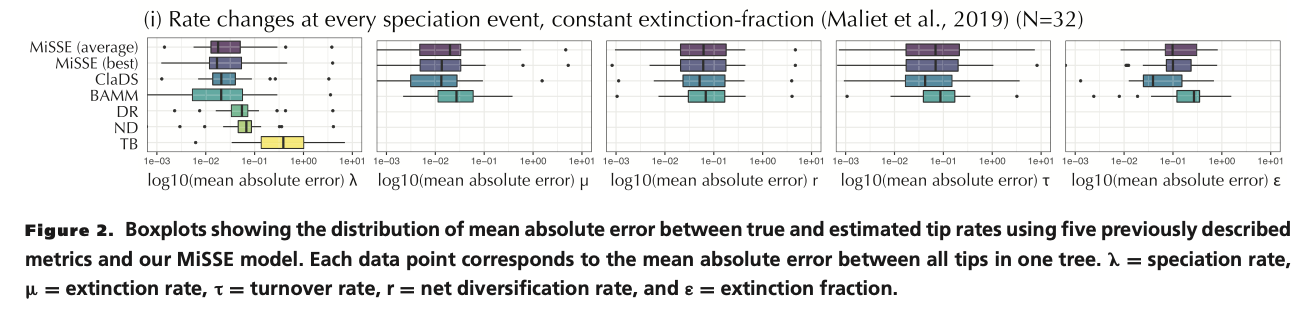
Unlike a lot of the other methods, this is a likelihood approach. Bayesian approaches are great for bringing in prior information: “how old is this clade when we its fossil record is rich but only starts 115 MYA?” – probably not exactly 115 MYA, but also not 330 MYA, either. But what do you think the net diversification rate should be in this clade? How many times should this rate have shifted? Few of us come to an analysis with this info. Running MiSSE lets the data alone give answers to these questions, rather than the answer being a mixture of what the data say and what we had to guess to run the analysis. Even if someone doesn’t want to use it as their sole method, it’s a good complement to analyses using CLaDS or BAMM (and performs far better than, say, DR, while giving info on more parameters). Give it a try today!
[And no, it’s not like it’s never used – it has 98 citations in Google Scholar so far, for example – but I still see a lot of papers where I think they might get better inferences about the biology by adding MiSSE to their workflow]
DateLife
- “Nothing in biology makes sense except in the light of evolution”: Dobzhansky, 1973
- “Nothing in evolution makes sense if your branch lengths are wrong”: O’Meara, 2026
Think of all we do in evolutionary biology (at least the parts I play in most frequently): estimating diversification rates, reconstructing ancestral states, checking character correlations, looking at changes in synonymous vs nonsynonmyous substitution rates, etc. The common denominator, often literally, are the branch lengths of a tree. Their estimation is a difficult problem, requiring tree inference, understanding of calibrations, boundaries in the likelihood surface, and more. Stephen Smith and I developed some software that helps with this, but, though free, I’m not including it in my Black Friday sale (its sales numbers are good already). But once someone has put in all the work to calibrate a tree properly using any of a variety of programs (RevBayes, r8s, Beast, MrBayes, iqtree, treepl, etc.) how can others benefit?
One approach to this is that used by https://timetree.org. It represents a tremendous amount of work: as I write this, it has info from 5,072 studies. It provides information from various studies to a user’s question about estimates of the divergence time of two taxa and, more recently, for a set of taxa. However, its model historically has been to keep all the raw information unshared and only present a reduced summary (see this older version of its FAQ). I found this frustrating – I think scientific data should be shared (though with appropriate citation), and just knowing there was a massive dataset out there but unavailable to the community was annoying. [There’s still no straightforward way to download the dataset from TimeTree, though there is now an email option to ask for more info, and the individual trees are more readily available, but that was not the case when I started working on Datelife].
However, there was open data on phylogenies: TreeBase (Piel, Donoghue, and Sanderson 2000). Its site seems down at the moment, but a few years ago I made a static mirror when it had a similar issue, so it’s still available at https://bomeara.github.io/treebasestatic/. When TreeBase was first created branch lengths just came from parsimony reconstructions, so it initially had no mechanism for storing branch length info, though this was later changed. Open Tree of Life ((Hinchcliff, Smith, …19 others… Cranson, 2015)[https://doi.org/10.1073/pnas.1423041112]), was its spiritual successor, and included explicit metadata on what branch lengths meant (millions of years, amount of change, etc.).
So, at a NESCent hackathon (Phylotastic) I started a team to address the need for an open way to assemble chronograms; this eventually became DateLife (Sánchez Reyes, McTavish, O’Meara 2024). There was a dedicated website; that is now housed within OpenTree and often unavailable (bots scraping are taking down a lot of websites lately). However, the R package was well-written (led by then postdoc Luna Sánchez Reyes) and continues to work.
It can be installed from github:
devtools::install_github("phylotastic/datelife")There is help at https://bomeara.github.io/datelife/. Some of the functionality:
- Go from a list of names to a chronogram
- Go from a cladogram to a chronogram
- Get the single largest published chronogram that matches some or all of your taxa
- Get the full set of all published chronograms that match some or all of your taxa
- Stretch a given tree using dates from other trees
The package is very careful to maintain citation info for all the chronograms you use – be sure to cite them in your work.
Let me know (omeara.brian@gmail.com) if you have issues or suggestions with DateLife. With the changes at Open Tree certain functions might have issues, though the fact that we have a chronogram tree store locally makes it somewhat robust.
New and Improved OUwie!
See this vignette on changes in OUwie as a result of an important correction found by Priscilla Lau, Bjørn Kopperud, and Sebastian Höhna. It affects the OUMA and OUMVA models.
Thanks
Our prices are low, low, low thanks to funding from the US National Science Foundation and taxpayers like you! And thanks to the R ecosystem for making so much of this possible.
To subscribe, go to https://brianomeara.info/blog.xml in an RSS reader.
Citation
@online{o'meara2026,
  author = {O’Meara, Brian},
  title = {Black {Friday} 2026 Software Sale},
  date = {2026-11-27},
  url = {https://brianomeara.info/posts/blackfriday2026/},
  langid = {en}
}